
Quick answer
All 3 formats use the same base tech (activated carbon), but serve different cases. Jug for family home use (€60-120/year, filters 3-4 L at a time). Faucet for high, unlimited consumption (~€80/year, up to 6 L/min). Filter bottle for personal use out of home (€60 every 18-20 months). Ideal for most: a jug at home + a bottle for out.
You've decided to filter your water — great, the most important call is made. Now comes the part where most people get lost: which format? There are 3 main options — jug, faucet filter and filter bottle. All use the same base tech but serve very different cases.
This guide helps you decide by real consumption profile. No marketing — honest comparison with 2026 prices.
Direct comparison table
| Jug | Faucet | Filter bottle | |
|---|---|---|---|
| Initial price | €25-40 | €40-70 | €40-60 |
| Annual cost (cartridges/filter) | €60-100 | €40-70 | €40 (changed every 18 months) |
| Speed | Slow (5-8 min per jug) | Fast (water on demand) | Fast (under pressure) |
| Capacity | 2-3.5 L (fridge) | Unlimited | 600-800 ml (mobile) |
| Filter lifespan | 100-200 L (2-3 months) | 600-1,200 L (4-8 months) | 1,500 L (18-20 months) |
| Install | None | 10-30 min with adapter | None |
| Removes chlorine | ✅ Yes | ✅ Yes | ✅ Yes |
| Removes bacteria | Partial (30-50%) | Partial (40-60%) | ✅ 99.99% (0.2 μm) |
| Removes microplastics | 85-95% | 85-95% | 90-99% |
Filter jug — the classic format
Brita, BWT, Xiaomi — all sell jugs with a replaceable activated-carbon cartridge. Most-sold format in Europe since the '90s.
When it's the best pick:
- Family consumption of 2-8 L/day
- Fridge-cool water
- Minimum initial budget (€30 and done)
- No plumbing changes
- Home use only
Weak spots:
- Expensive cartridges long-term: €60-100/year in cartridges vs €40/year for a filter bottle
- Takes up space in the fridge or counter
- Limited bacterial filtration:activated carbon alone doesn't filter bacteria (no 0.2 μm mechanical barrier). Not usually a problem in Europe because tap water arrives bacteria-free, but if your tap has occasional issues (old flat, albergue), a jug doesn't fully solve it.
- Slow filtering: 5-8 min per jug. If you run out and have visitors, you wait.
Models that work:
- Brita Marella XL 3.5 L — €30. The standard. MaxTella Pro cartridges 4 weeks (~€4/month).
- BWT AquaLizer — €40. Adds magnesium, improves taste.
- Xiaomi Mi Water Filter Pitcher — €25. Good value, cheaper cartridges than Brita.
Faucet filter — the installed format
Screws directly onto the tap or goes under the sink. Filters instantly without taking counter space.
When it's the best pick:
- High usage: cooking + drinking + coffee + tea (8-15 L/day)
- You cook with filtered water (pasta, rice, soup)
- Large families (4+ people)
- You hate having a jug taking up space
- You live in your own home (not short-term rental)
Weak spots:
- Install: 10-30 min with screwdriver and adapter. Rentals → check with landlord.
- Reduced water pressure — filters cut flow 20-40%. Noticeable when washing many dishes.
- Brand-specific cartridges: tied to the supplier. If Brita raises prices, tough luck.
- Not portable: only works on that tap.
Models that work:
- Brita On Tap V-MF — €50. Easy install, filters 1,200 L (4-6 months).
- Culligan Faucet Filter — €60. NSF/ANSI 42+53 certified.
- PureMax under-sink — €130 + install (plumber). Higher capacity but higher investment.
Filter bottle — the mobile format
Bottle with built-in filter. Fill at any source (home tap, office, public fountain, river) and drink on the spot.
When it's the best pick:
- You work out of home (office, site, outdoors)
- You travel a lot (plane, trains, hotels)
- Camino, hiking, vanlife, camping
- Gym sessions
- You live where water quality varies (old plumbing, albergues)
Unique points the other 2 don't cover:
- Portability — the only one you can put in a bag
- Pressure filtration:best models (0.2 μm + activated carbon) also filter bacteria, which jugs and faucet filters don't do as well
- Long lifespan per unit: 1,500 L = 18-20 months of daily use. Better cost/litre ratio than the others.
- Multi-function: home + office + travel + outdoor with one purchase
Weak spots:
- Limited capacity per bottle (600-800 ml). Not for bulk cooking.
- Needs maintenance — rinse every few days to avoid biofilm inside.
Models that work:
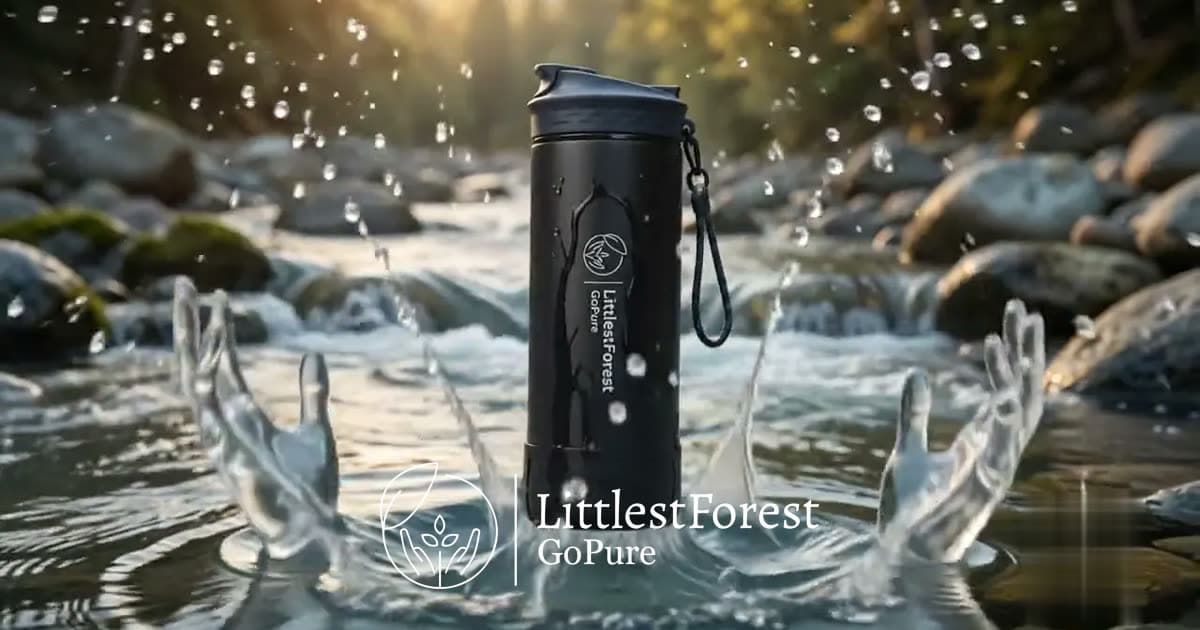
- GoPure (LittlestForest) — €60. 800 ml, 0.2 μm + activated carbon, 1,500 L. Highest capacity and lifespan.
- LifeStraw Go 2.0 — €40. 650 ml, 0.2 μm no carbon. Cheaper but lets chlorine taste through.
- Katadyn BeFree — €50. 600 ml, ultra-light (60 g) — but soft flask, not rigid.
Real cost over 5 years
| Format | 5-year cost | Litres filtered | €/L |
|---|---|---|---|
| Brita jug | €430 | 3,650 L | €0.118 |
| Brita On Tap faucet | €330 | 7,300 L | €0.045 |
| GoPure filter bottle | €195 | 4,500 L | €0.043 |
| Bottled water (baseline) | €1,400 | 3,650 L | €0.384 |
Based on 2 L/day over 5 years. Filter bottle = 3 replacements in 5 years (a new one every 18-20 months).
Recommendation by profile
Family of 3-5 at home
Big jug (Brita Marella XL) for home use + one filter bottle for each member who takes water out. Covers all scenarios without overspending.
Solo person or couple, office job
Just a filter bottle. Refill at home or office tap. €60 every 18 months, no cartridges, no space taken.
Large family with heavy cooking water usage
Faucet filter + a spare jug in fridge. Faucet covers cooking and drinking, jug has cold water always ready.
Pilgrim or vanlifer
Just a filter bottle. No point installing anything. One bottle covers all scenarios (albergue tap, rural fountain, clear river).
Student in shared rental
Just a filter bottle. No installing anything, no jugs fighting for shared fridge space. Portable and personal.
Office or coworking without filtered water
Personal filter bottle — each their own. Alternative: pool between coworkers for one big jug.
The optimal combo used by those in the know
People who've tried all 3 formats usually end at the same setup:
- Brita jug for home — coffee, cooking and cold water in fridge (€35/year amortised)
- Filter bottle for out — office, gym, travel, hiking (€40/year amortised)
- Zero bottled water — only real emergency
Total: €75/year for filtered hydration 24/7. Compared to bottled (€280/year) you save €205 and 1,500 plastic bottles. And you ingest 1,000× less microplastic.
FAQ
Can I use a filter just for coffee/tea?
Yes, and you'll notice the difference in 2 days. Chlorine ruins coffee aroma and green tea's delicate flavour. Recommendation: jug on the counter.
Do filters add minerals?
Some do (BWT AquaLizer adds magnesium). Most just remove. If you care about mineralisation, look for the ones that say "with enrichment" on the spec sheet.
Do I need to refrigerate filtered water?
Ideally yes — filtering removes chlorine that prevented bacterial growth. Without chlorine, filtered water lasts 24-48 h at room temperature before bacteria start growing. In the fridge it lasts 5-7 days.
Is reverse osmosis better?
Filters more but also removes beneficial minerals, costs €200-500 to install, and wastes 3-4 L per L filtered. Only makes sense in very hard water areas or specific chemical issues (arsenic, high nitrates).
What if I forget to change the cartridge?
A spent cartridge starts releasing contaminants instead of holding them. Rule: always in the month due. Set a phone reminder.
Bottom line
There's no universally best format. It depends on your situation:
- Fixed home + family = jug or faucet
- Mobile use = filter bottle
- Both scenarios = both formats (€75/year)
Any of the 3 is infinitely better than bottled. You save money, plastic and microplastics. The only bad call is not filtering.